
Ronak Ahmad
Sculptor
Her artistic practice revolves around the body as a living memory, carrying traces of loss, violence, and survival. In her work, she explores the impact of war on the human being, and how lived experiences are transformed into features, distortions, and forms that hold what is difficult to express in words.
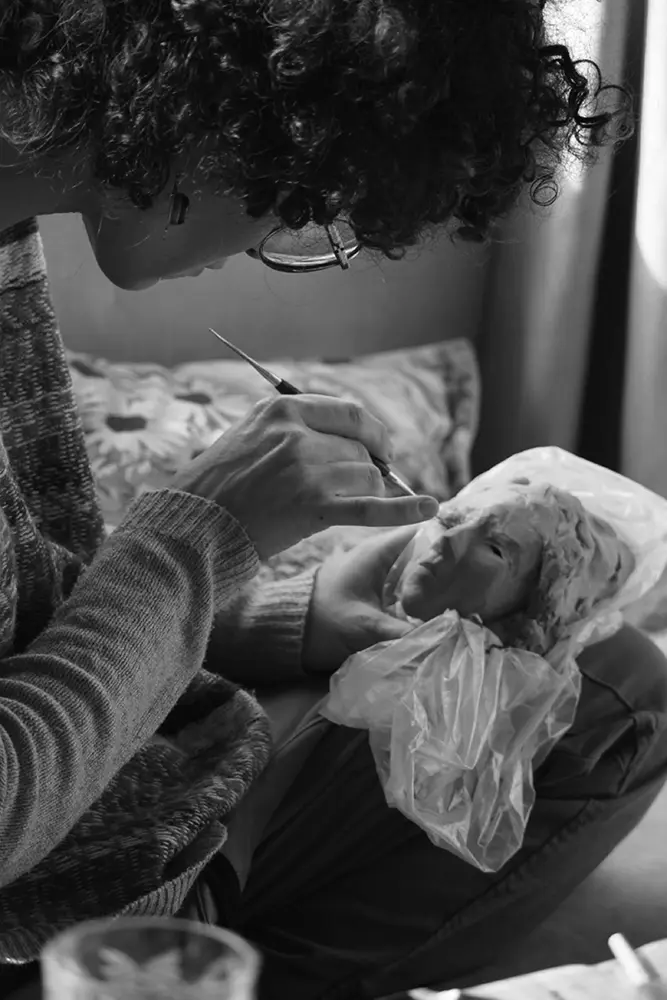
Her relationship with art began in childhood, and she chose sculpture as her field of study in 2005. Working with clay, she approaches the body not merely as a visual form, but as a space in which human experiences accumulate—a mirror bearing the traces of both the individual and the places in which they have lived.
She begins with an image, an event, or a real face, then reconstructs it in her memory before moving to the clay. Working directly with the material allows her to engage closely with the details and transformations of the body. She is drawn to forms that bear traces of violence and loss, not simply to document suffering, but to understand what it leaves behind in a person, and what remains after survival.
She sees the body as an extension of the memory of place, and distortion as the imprint of an experience that does not end when the event that caused it is over. Through sculpture, she explores the relationship between what a person loses and what they carry with them, and between the vulnerability of the body and its capacity to contain memory and continue living.
She does not seek to offer answers or a complete narrative, but rather to create a space for reflection on the human experience, where material becomes a vessel for what cannot be said, and the body becomes a witness to what happened—and to what remains of it.